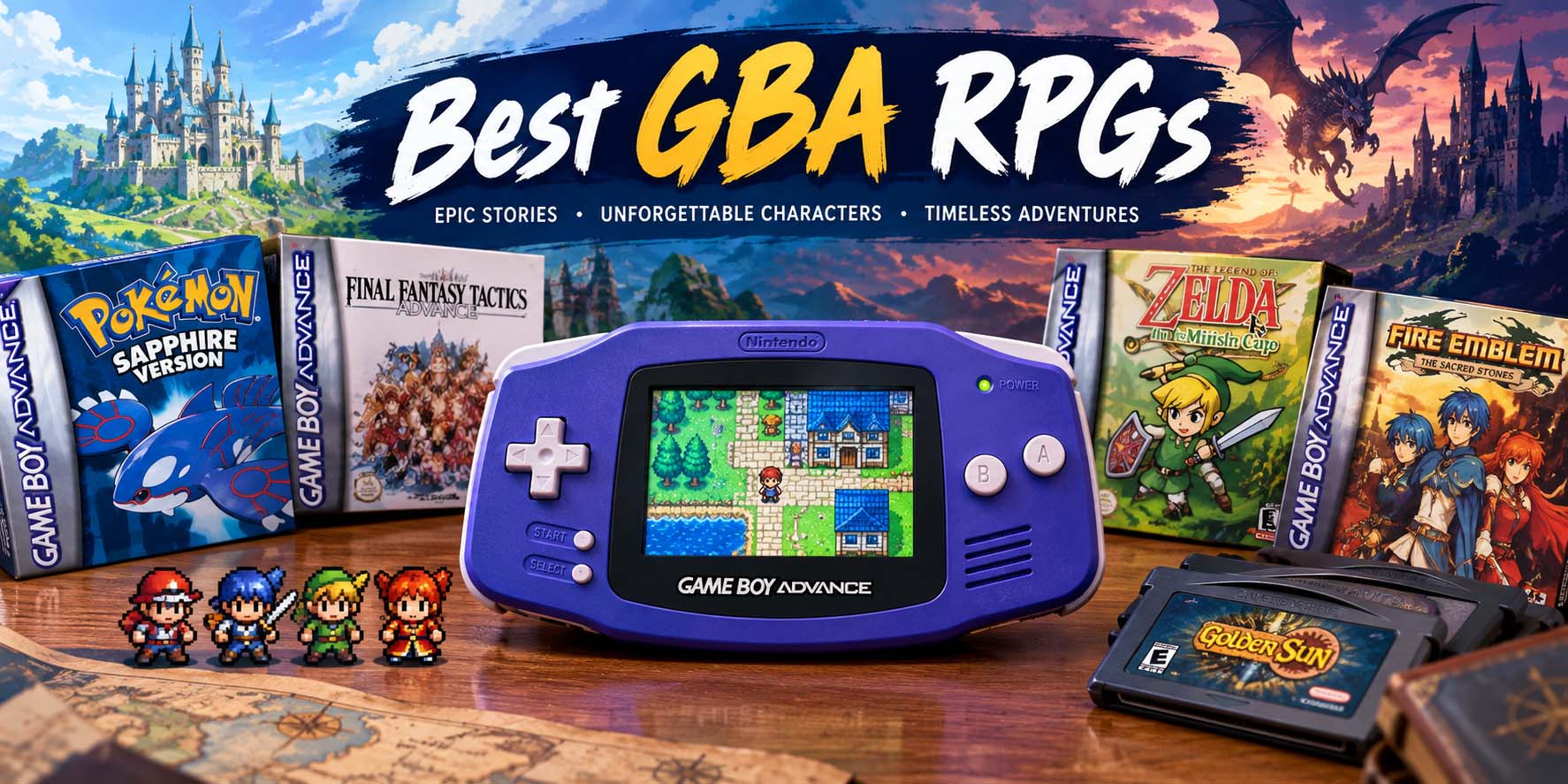
The best GBA RPGs showed how naturally role-playing mechanics could fit portable gaming. Games such as Pokémon Emerald, Golden Sun, Fire Emblem, Final Fantasy Tactics Advance, and Mario & Luigi: Superstar Saga offered progression, exploration, strategic combat, and memorable worlds in formats that worked well across both short and extended play sessions. More importantly, these games did not all follow the same formula.
The Game Boy Advance became particularly interesting for RPG fans because its library covered traditional turn-based adventures, tactical RPGs, creature-collecting games, and more action-oriented variations of the genre.
Why Did RPGs Work So Well on the Game Boy Advance?
RPGs are built around systems that translate naturally to handheld play.
Character progression can continue gradually across many sessions. Turn-based combat does not usually demand constant high-speed reactions, while exploration gives players clear reasons to return to an ongoing adventure.
The GBA’s portable format also suited games with frequent milestones. Players could complete a battle, explore a new area, adjust a party, collect an item, or advance the story and still feel they had made progress.
This flexibility allowed RPGs to feel substantial without requiring every play session to be lengthy.
The Best GBA RPGs Offered Different Types of Progression
One reason the best GBA RPGs remain interesting is that progression could mean something different in each game.
Pokémon Emerald centers much of its progression on catching Pokémon, developing a team, learning moves, exploring new areas, and overcoming increasingly difficult battles.
Golden Sun follows a more traditional party-based RPG structure. Characters develop throughout the adventure while exploration, puzzles, equipment, and turn-based combat support the broader journey.
Fire Emblem approaches progression from a tactical perspective. Individual units develop over time, but their value also depends on battlefield positioning, movement, weapon choices, and strategic decisions.
Mario & Luigi: Superstar Saga combines familiar RPG progression with timing-based interactions during combat.
These different approaches prevent the GBA’s RPG library from feeling like a collection of identical experiences.
Tactical RPGs Added Another Layer of Strategy
Tactical RPGs were particularly well suited to the system because they combined character development with carefully structured battles.
Fire Emblem asks players to think about unit placement, movement ranges, enemy threats, terrain, and individual character strengths. Battles are not simply about having stronger characters; positioning and decision-making also matter.
Final Fantasy Tactics Advance offers another tactical approach, using grid-based encounters, character development, jobs, abilities, and party customization.
These systems encourage players to think beyond individual attacks.
A tactical RPG creates satisfaction by connecting long-term character development with short-term battlefield decisions. Players improve their party between encounters and then decide how to use those improvements during combat.
Pokémon Made Team Building Central to the RPG Experience
Pokémon represents a distinct branch of handheld role-playing.
Rather than relying on a fixed party of characters, the series allows players to catch creatures and create their own team. That makes party composition a central part of progression.
Different Pokémon have different strengths, weaknesses, moves, and roles. As players learn these relationships, team building becomes increasingly strategic.
At the same time, the basic structure remains approachable. Players explore routes and towns, battle trainers, catch Pokémon, and work toward recognizable objectives.
This combination of accessibility and deeper systems helps explain why Pokémon became such a natural fit for portable gaming.
Players who want to compare RPGs with action, racing, platforming, strategy, and other genres can also explore broader recommended GBA games to see how role-playing titles fit within the larger Game Boy Advance library.
Golden Sun Showed the Strength of Traditional Handheld RPGs
Golden Sun demonstrates how a more traditional fantasy RPG could work effectively on the GBA.
Its appeal comes from several connected elements: exploration, party development, puzzles, turn-based battles, abilities, and a continuing adventure.
The game also illustrates why RPGs can benefit from combining progression with exploration.
Character abilities are not useful only during combat. They can also interact with the environment, making the world itself part of the player’s problem-solving experience.
This gives exploration a stronger purpose because progression can change how players understand and interact with locations.
Mario & Luigi Added More Interaction to Turn-Based Combat
Turn-based combat does not have to mean passive combat.
Mario & Luigi: Superstar Saga uses timing-based actions to make battles more interactive. Players are encouraged to pay attention during attacks rather than simply selecting a command and watching the result.
This creates a different rhythm from Pokémon, Golden Sun, or a tactical RPG.
Humor and character interactions also help give the game a distinct identity.
The result demonstrates an important strength of the GBA RPG library: developers could experiment within the genre without abandoning its core progression systems.
Portable Play Made Long Adventures Easier to Approach
RPGs are often associated with long adventures, which might seem unusual for a portable system.
In practice, handheld gaming can make lengthy games more approachable.
Players do not necessarily need to complete an RPG in long sessions. They can progress gradually, handling a few battles, exploring a location, adjusting equipment, or completing part of an objective whenever time is available.
A strong save system and clear progression make this approach much easier.
As a result, a large RPG can work both as a long-form adventure and as something experienced across many shorter sessions.
Story Matters, but Gameplay Systems Matter Too
RPGs are frequently associated with storytelling, yet story alone does not determine whether a handheld RPG remains enjoyable.
Players spend significant time interacting with battle systems, menus, characters, equipment, exploration mechanics, and progression systems. If those elements become tedious, even an interesting story may struggle to maintain attention.
The strongest GBA RPGs connect their systems effectively.
Combat contributes to character growth. Exploration leads to discoveries. New abilities create additional strategic possibilities. Party customization gives players more control over how they approach challenges.
When these systems reinforce each other, progression feels meaningful rather than mechanical.
Which Type of GBA RPG Should You Play?
The right choice depends on what you enjoy most about role-playing games.
Choose a traditional RPG if you enjoy party development, exploration, story progression, equipment, and turn-based combat. Golden Sun is a recognizable example.
Choose a tactical RPG if battlefield positioning, unit management, and strategic decisions are more appealing. Fire Emblem and Final Fantasy Tactics Advance represent this style.
Choose a creature-collecting RPG if you enjoy building your own team and experimenting with different combinations. Pokémon Emerald is an obvious starting point.
Choose a more interactive turn-based RPG if you prefer combat that incorporates timing and active input. Mario & Luigi: Superstar Saga provides that variation.
The GBA library supports these different preferences without reducing RPGs to one design formula.
Why GBA RPGs Still Stand Out
RPGs became one of the Game Boy Advance’s strongest genres because the system supported what role-playing games do particularly well: gradual progression, exploration, strategic decision-making, character development, and long-term goals.
At the same time, developers approached those ideas differently. Pokémon emphasized collecting and team building. Golden Sun delivered a traditional fantasy adventure. Fire Emblem and Final Fantasy Tactics Advance focused on tactical combat, while Mario & Luigi added timing and humor to turn-based systems.
That diversity is what makes the best GBA RPGs more than a group of similar games. They demonstrate how one genre can support very different experiences while remaining naturally suited to portable play.