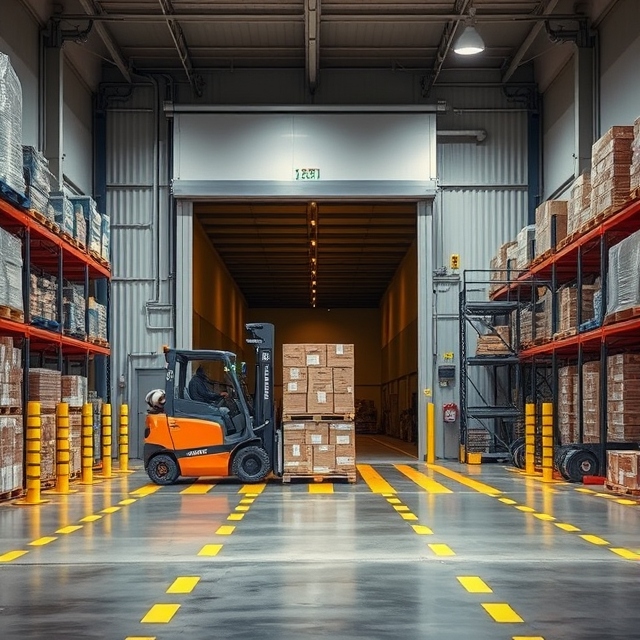
Cold-storage doorways become much more demanding when forklifts, pallet trucks, and other material-handling equipment use them throughout the day. A doorway that works well for occasional personnel access may create delays, safety concerns, or unnecessary temperature exposure when it becomes part of a busy warehouse traffic route.
For that reason, freezer door for forklift traffic design should consider more than the door itself. Opening dimensions, traffic frequency, operating speed, visibility, safety systems, insulation, sealing, and the layout of the surrounding aisle all influence how effectively the access point performs.
Why Forklift Traffic Changes Cold-Storage Door Requirements
Forklifts need considerably more clearance than personnel, and their movement through a cold-storage doorway can be repetitive throughout a shift.
Every unnecessary stop can interrupt material flow. If operators must leave the vehicle to operate a manual door, wait for a slow opening cycle, or maneuver around a door leaf, the access point can become a bottleneck.
The doorway also separates two environments that may have significantly different temperatures. When it remains open during repeated forklift movements, warm and humid air can enter the refrigerated area while cold air escapes.
ASHRAE guidance for refrigerated facilities specifically notes that heavy-traffic doorways should provide high traffic capacity while minimizing refrigeration loss and maintenance requirements. It also identifies automatic doors as particularly important for forklift and automated material-handling systems.
Start With the Traffic Pattern
Before selecting a door, examine how vehicles actually approach and leave the opening.
Important questions include:
- How many forklift movements occur during a typical hour?
- What type of forklift or pallet truck is being used?
- Does the vehicle carry single or multiple pallets?
- Does traffic move in both directions?
- Do pedestrians use the same doorway?
- Is the doorway located on a straight aisle or near an intersection?
- Are there blind corners or restricted visibility areas?
- How much space is available beside the opening?
A low-frequency storage entrance has different requirements from an opening serving continuous movement between a freezer and a picking or staging area.
The traffic route should also be considered as part of the door design. Visibility around the doorway matters because forklift operators may have limited sightlines when approaching an opening, particularly where pedestrians or vehicles can approach from another direction.
Choose the Opening Size Around the Actual Load
Door dimensions should be based on the complete vehicle-and-load combination rather than the forklift alone.
The clear opening needs to accommodate:
- The forklift’s overall width.
- The maximum pallet or product load.
- The height of the load.
- Required maneuvering clearance.
- Any variation between different handling vehicles.
A doorway that is technically large enough for an unloaded forklift may become difficult to use when the vehicle is carrying a wide or tall pallet.
ASHRAE notes that cold-storage door openings serving forklifts need appropriate clearance around pallet loads, while door height should accommodate the equipment and stacking arrangement used in the facility.
The goal is not simply to make the opening as large as possible. An oversized opening can increase the area through which conditioned air is exchanged whenever the door is open. The better approach is to provide sufficient operational clearance without creating unnecessary open space.
Consider Sliding and High-Speed Access
Door selection becomes particularly important when forklift traffic is frequent.
Horizontal sliding doors can work well where large insulated openings are required and the facility needs a substantial physical barrier when the doorway is closed. They also avoid the swing arc of a hinged door, which can be valuable where forklift aisles are close to the doorway.
For industrial applications involving repeated movement, sliding freezer doors can be considered as part of the overall access strategy, particularly where insulation, large openings, and controlled separation between temperature zones are important.
High-speed doors address a different part of the problem: reducing the amount of time that the opening remains exposed during frequent traffic.
The choice therefore depends on the operating environment. A facility may prioritize a heavily insulated sliding closure, rapid operation, or a combination of door systems where traffic volume and temperature separation justify it.
Opening Speed Matters in Busy Areas
A forklift doorway does not need to be fast simply for convenience. Opening speed affects the amount of time the cold room is exposed to the surrounding environment.
A typical traffic cycle can involve:
Vehicle approaches → door activates → opening clears → forklift passes → vehicle clears doorway → door closes
If the operator has to stop and manually open the door during every cycle, the process can slow down material movement. Automatic activation can allow the door to respond as the vehicle approaches, provided the sensors and safety controls are properly configured.
The appropriate activation method may include motion detection, radar, photoelectric sensors, pull cords, remote controls, or other systems suited to the facility.
Don’t Overlook Insulation and Sealing
Fast operation is only one part of cold-storage access design.
The closed door also needs to provide an effective thermal separation between the cold room and adjacent areas. Important details include:
- Insulated door construction
- Perimeter gaskets
- Frame design
- Proper alignment
- Floor and threshold details
- Protection against air leakage
- Resistance to moisture and frost
- Appropriate materials for the operating temperature
A door can have excellent insulation but still perform poorly if its seals are damaged, the frame is misaligned, or the door remains open unnecessarily.
Repeated forklift traffic can also increase mechanical wear, making routine inspection important.
Build Safety Into the Doorway
A forklift-access door should be treated as part of the facility’s traffic-management system.
Safety considerations can include:
- Presence detection
- Photoelectric safety sensors
- Safety edges
- Automatic reversal where applicable
- Emergency release mechanisms
- Warning indicators
- Adequate visibility
- Protected door equipment
- Clearly defined vehicle and pedestrian routes
Door positioning matters as well. ASHRAE recommends avoiding irregular aisles and blind spots around heavy-traffic refrigerated doorways.
Where forklifts and pedestrians share an access route, separating their movement paths can reduce conflicts and make the doorway easier to operate safely.
Account for Frost and Moisture
Freezer doorways are particularly sensitive to moisture entering from warmer areas.
When humid air reaches a sufficiently cold surface, condensation and frost can form around frames, tracks, seals, and other components. Continued accumulation can interfere with door movement and increase maintenance requirements.
The design should therefore consider:
- Door sealing
- Traffic frequency
- Opening duration
- Temperature difference
- Local humidity
- Drainage
- Frame and threshold details
- Frost-control measures where required
Reducing unnecessary door-open time is one part of the solution. Keeping the door properly maintained is equally important.
Design the Whole Material-Handling Route
A good freezer doorway cannot compensate for a poorly designed traffic route.
Look at the complete movement path from the storage position to the destination. The forklift should have adequate approach space, a clear sightline, and enough room to enter and exit without excessive maneuvering.
The doorway should also be positioned so that opening and closing does not interfere with adjacent equipment, racks, pedestrian paths, or another door.
For high-volume operations, it can be useful to map the traffic flow and identify where vehicles are forced to slow down or wait. If one doorway repeatedly creates delays, changing the door alone may not solve the underlying problem.
A Practical Selection Checklist
Before specifying a cold-storage access door for forklift traffic, confirm:
- Traffic frequency: How often will the doorway cycle?
- Vehicle dimensions: What are the maximum forklift dimensions?
- Load dimensions: What is the largest pallet or product load?
- Opening size: What clear width and height are actually required?
- Temperature: Is the opening serving a chilled room, freezer, or deep-freeze area?
- Operating speed: How quickly must the door open and close?
- Insulation: What level of thermal separation is required?
- Sealing: How will air leakage and moisture entry be controlled?
- Safety: What sensors, emergency releases, and protection systems are needed?
- Maintenance: Can tracks, seals, sensors, and operating components be inspected easily?
- Traffic layout: Are forklifts and pedestrians safely separated where necessary?
Answering these questions before ordering the door helps ensure that the access system matches the actual operating conditions.
Final Thoughts
Designing cold-storage access for forklift and material-handling traffic requires a balance between throughput, temperature control, safety, durability, and available space. The right solution depends on how frequently the doorway is used, what equipment passes through it, the dimensions of the loads, and the temperature difference between the connected areas.
Rather than selecting a door based only on its opening size or insulation, facilities should evaluate the complete traffic cycle and the conditions surrounding the doorway. When the door, activation system, safety equipment, sealing, and warehouse layout are considered together, the access point can support smoother material movement while maintaining the separation required by temperature-controlled operations.