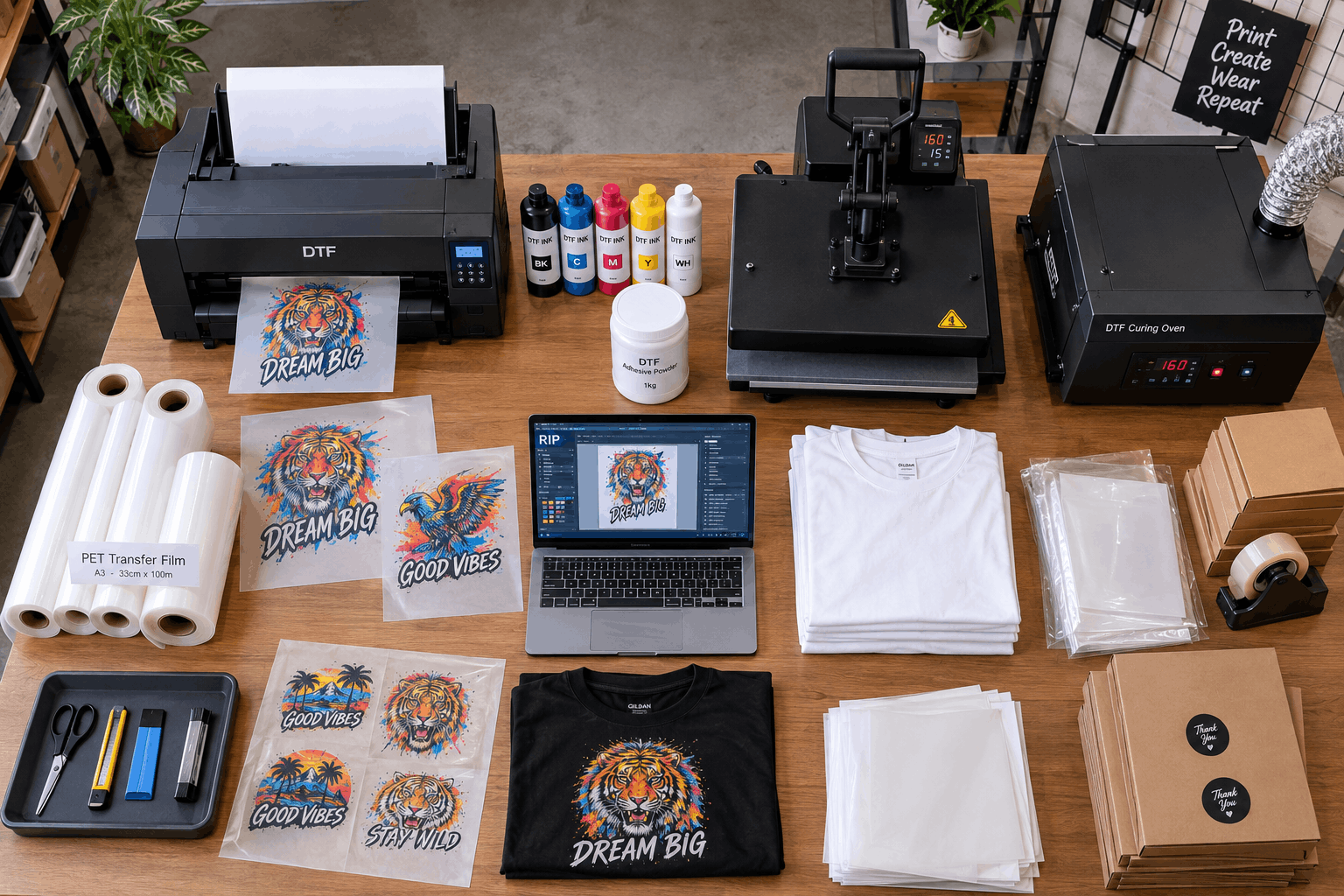
Understanding DTF printer setup cost requires looking beyond the printer itself. A small DTF printing business may need a printer, heat press, curing equipment, transfer film, DTF ink, adhesive powder, RIP software, blank garments, maintenance supplies, and a suitable workspace.
The total investment therefore depends on the equipment configuration and the way you plan to operate. A home-based seller producing occasional custom T-shirts may have very different requirements from a small apparel operation handling regular orders.
What Makes Up the Cost of a DTF Setup?
A useful way to estimate startup costs is to divide the setup into several categories:
- Printing equipment
- Transfer and printing consumables
- Powder application and curing
- Heat pressing
- Software and computer equipment
- Blank garments
- Maintenance supplies
- Workspace and storage
- Packaging and order fulfillment
This approach gives a more realistic picture than comparing printer prices alone.
1. The DTF Printer
The printer is usually the most obvious equipment purchase, but it should be selected according to the type of work you expect to produce.
Consider the size of your designs, expected order volume, available workspace, and plans for future expansion.
A compact printer may be suitable for a small home operation with limited space and modest production requirements. A larger-format machine may make more sense when the business needs larger graphics or a broader apparel range.
Before choosing a machine, it can be helpful to review a practical DTF printer setup guide that considers factors such as printer format, business requirements, maintenance, and production needs rather than treating the printer price as the only consideration.
2. DTF Ink and Transfer Film
Ink and PET transfer film are recurring operating expenses.
DTF printers generally use CMYK inks along with white ink. The amount consumed will depend on the artwork, print settings, coverage, and production workflow.
Transfer film is another ongoing requirement because each transfer starts with a suitable film surface.
When estimating your startup budget, include an initial supply of compatible ink and film rather than assuming the printer purchase covers all printing materials.
3. Adhesive Powder and Curing
Hot-melt adhesive powder is used after the design is printed onto the transfer film. It creates the bonding layer needed for the design to adhere to the garment during heat pressing.
The powder also introduces another part of the setup: curing.
Depending on the workflow and equipment, curing may involve dedicated equipment or another appropriate method. The choice can affect the amount of space required and the overall startup budget.
For a home business, powder handling and curing should also be considered from a workspace and safe-handling perspective.
4. Heat Press Equipment
A DTF transfer still needs to be applied to the garment, so a suitable heat press is an important part of the setup.
The press should match the garments and design sizes you expect to produce. Think about whether you will mainly make small T-shirt graphics or also work with larger designs, hoodies, bags, or other compatible apparel.
A heat press should not be treated as an optional accessory. It is part of the production workflow that turns a prepared transfer into a finished product.
5. RIP Software and Artwork Preparation
RIP software helps manage the printing process and can control functions such as color handling and white-ink output.
Some printers are supplied with or designed to work with specific software. Before purchasing equipment, check which software is supported and whether the workflow is appropriate for your level of experience.
You may also need a computer capable of handling your artwork preparation and printing workflow. If you already have suitable equipment, this part of the startup cost may be lower than for someone building the entire workstation from scratch.
6. Blank Garments
A printing business needs products to decorate.
T-shirts are a common starting point, but depending on the business model, you may eventually offer hoodies, tote bags, uniforms, workwear, or other compatible items.
Avoid treating garment inventory as an afterthought. Different colors, sizes, styles, and materials can increase the amount of money tied up in stock.
A small operation can start with a focused selection that matches its intended customers and expand the range as demand becomes clearer.
7. Maintenance and Cleaning Supplies
DTF equipment requires routine maintenance, and the cost of maintaining the printer should be included in the business plan.
White ink deserves particular attention because it can settle and requires appropriate circulation and maintenance procedures. Regular nozzle checks, cleaning, and other maintenance tasks should follow the manufacturer’s instructions.
Budgeting for cleaning materials and maintenance supplies can help prevent routine care from becoming an unexpected expense.
8. Workspace and Storage
A home-based DTF business may not require a dedicated commercial unit, but it still needs an organized production area.
The workspace should accommodate the printer, computer, heat press, curing process, consumables, blank garments, and finished products.
Storage is particularly important. Ink, film, adhesive powder, clothing stock, packaging materials, and cleaning supplies can quickly create clutter if there is no designated space.
When estimating your setup requirements, consider the entire workflow rather than only the footprint of the printer.
Initial Setup Cost vs Ongoing Cost
One of the most important distinctions for a new business is the difference between startup expenses and operating expenses.
Initial expenses may include:
- DTF printer
- Heat press
- Curing equipment
- Computer or workstation
- Initial ink and film
- Adhesive powder
- Initial garment inventory
- Maintenance supplies
- Workspace equipment
Ongoing expenses may include:
- DTF ink
- Transfer film
- Adhesive powder
- Blank garments
- Cleaning supplies
- Packaging
- Electricity
- Equipment maintenance
- Software costs, where applicable
This distinction makes it easier to understand how much money is needed to start and how much will be required to continue producing orders.
How Can You Keep a DTF Startup Budget Under Control?
The safest way to control costs is to buy according to your actual business requirements.
First, determine the products you want to sell. Then estimate the design sizes, expected order volume, and workspace available.
Next, build the equipment list around those requirements.
For example, a business focused on personalized T-shirts may prioritize a compact printing setup, suitable heat press, basic garment inventory, and efficient artwork preparation. A business planning to serve larger apparel orders may need greater print capacity and more production space.
Avoid purchasing equipment simply because it has more features than you currently need.
Is a Cheap DTF Printer Always the Lowest-Cost Option?
Not necessarily.
The purchase price is only one part of the total cost. Consumables, maintenance, workflow efficiency, replacement parts, workspace requirements, and additional equipment also affect the economics of a DTF operation.
A printer that appears inexpensive may not be suitable if it cannot support the design sizes or production requirements of your intended products.
Conversely, buying a more capable system than your business needs can tie up money that could otherwise be used for garments, marketing, packaging, or working capital.
Questions to Ask Before Starting
Before calculating your final budget, answer these questions:
What products will I sell?
Decide whether you will focus on T-shirts or offer a broader range of compatible apparel.
How large will my designs be?
Your typical design dimensions can influence the printer format and heat press requirements.
How much space do I have?
Measure the area available for printing, curing, pressing, storage, and packaging.
How much inventory do I need?
Start with a manageable selection of garments and expand based on actual demand.
How will I handle maintenance?
Understand the printer’s cleaning and white-ink procedures before beginning regular production.
What are my recurring consumable costs?
Estimate ink, film, powder, garments, packaging, and maintenance supplies separately from the initial equipment purchases.
Plan the Business, Not Just the Printer Purchase
The real DTF printer setup cost comes from building a complete production system. A printer without compatible film, ink, powder, curing, heat pressing, maintenance, and suitable garments cannot function as a complete apparel business.
A practical budget should therefore cover both the initial equipment and the recurring costs of production. By matching the setup to your products, available space, expected workload, and future plans, you can create a clearer financial picture before committing to the equipment.