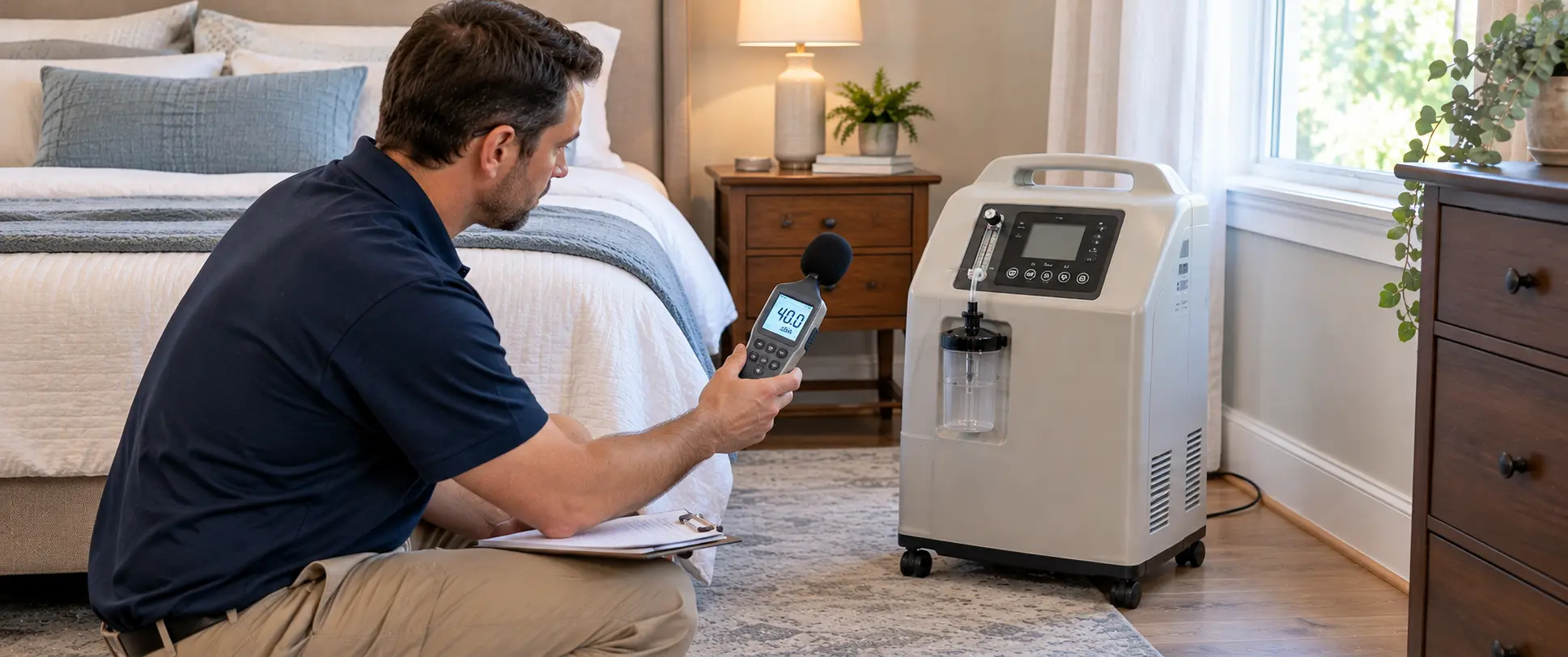
Home oxygen concentrator noise is an important consideration when selecting medical equipment for everyday use, particularly in bedrooms, shared living spaces, and smaller apartments. Most stationary oxygen concentrators produce some operating sound because they contain compressors, cooling systems, and moving components.
A quieter concentrator can improve comfort, especially when equipment operates for extended periods. However, noise levels vary between models, and the quietest device is not necessarily the most appropriate for every patient.
Understanding decibel ratings, equipment placement, and normal operating sounds helps buyers compare concentrators more accurately.
What Is a Normal Home Oxygen Concentrator Noise Level?
Many modern stationary oxygen concentrators have manufacturer-published noise ratings around 40–50 decibels A-weighted (dBA), although some models operate outside this range.
The exact sound level depends on the concentrator’s design, operating conditions, and measurement method.
A machine rated at approximately 40 dBA may produce a relatively gentle background sound in a typical home environment.
However, perceived noise varies between individuals. A sound that one person barely notices may disturb another person’s sleep.
Therefore, buyers should consider both published specifications and the environment where the equipment will operate.
Understanding Oxygen Concentrator Decibel Ratings
Manufacturers commonly measure equipment noise using the decibel scale.
A-weighted decibels, written as dBA, account for the sensitivity of human hearing to different sound frequencies.
Unlike a simple linear measurement, the decibel scale is logarithmic.
Consequently, a small numerical difference can represent a meaningful change in sound intensity.
Comparing Oxygen Concentrator Noise Levels in Decibels
The following comparisons provide general context rather than exact predictions of how a concentrator will sound.
| Noise Level | General Sound Comparison |
|---|---|
| 30 dBA | Very quiet indoor environment |
| 40 dBA | Quiet room or soft background sound |
| 50 dBA | Moderate indoor background noise |
| 60 dBA | Normal conversational sound at a typical distance |
Actual sound perception depends on distance, background noise, room acoustics, and the character of the sound.
Additionally, manufacturers may use different testing conditions. Therefore, two published ratings are most useful when their measurement methods are comparable.
Why Do Home Oxygen Concentrators Make Noise?
Stationary oxygen concentrators use mechanical and electrical components to produce oxygen-enriched gas from surrounding air.
Several parts contribute to their operating sound.
Compressor Noise During Oxygen Production
The compressor pressurizes incoming air before it passes through the concentrator’s gas-separation system.
This process can produce a continuous humming or vibrating sound.
Compressor design and vibration control influence how noticeable the sound becomes.
Cooling Fan Noise and Airflow
Concentrators require ventilation to maintain appropriate internal operating temperatures.
Cooling fans and moving air can create a soft rushing or whirring noise.
However, users should never restrict airflow simply to make the machine quieter.
Internal Valve Clicking Sounds
Many concentrators use pressure swing adsorption technology, which involves alternating pressure cycles.
Internal valves control these cycles and may produce periodic clicking or switching sounds.
Some rhythmic sounds are normal for particular models. However, users should investigate unfamiliar or unusually loud noises according to the manufacturer’s instructions.
How to Compare Home Oxygen Concentrator Noise Ratings
When comparing stationary oxygen equipment, buyers should examine the manufacturer’s published acoustic specifications.
For example, this DeVilbiss 5L home oxygen concentrator is a stationary continuous-flow model with a published operating noise specification of approximately 40 dBA.
This provides a useful reference when examining how different home oxygen concentrators compare.
However, a manufacturer’s noise specification does not guarantee identical sound levels in every room.
The surrounding environment, equipment condition, and distance from the listener can affect the experience.
Buyers should also remember that oxygen delivery requirements, reliability, and appropriate monitoring features are more important than selecting equipment based only on noise.
How to Reduce Home Oxygen Concentrator Noise
Proper positioning can help reduce the perceived sound of an oxygen concentrator without interfering with safe operation.
Place the Oxygen Concentrator on a Stable Surface
Position the concentrator on a firm, level surface according to the manufacturer’s instructions.
An unstable surface may increase vibration or create additional rattling.
Therefore, avoid placing equipment where someone could easily knock it over or obstruct its ventilation openings.
Maintain Adequate Ventilation for Quiet Operation
Concentrators require clear air intake and exhaust pathways.
Placing equipment inside a cabinet, covering it with fabric, or positioning it against ventilation openings can interfere with operation.
Always maintain the clearance specified in the user manual.
In addition, adequate ventilation helps the machine operate under its intended conditions.
Adjust Equipment Distance and Room Layout
When medically appropriate and permitted by the manufacturer’s instructions, positioning a concentrator farther from the sleeping area may reduce perceived noise.
However, tubing length and placement must remain compatible with the prescribed oxygen delivery arrangement.
Patients should consult their equipment provider before making significant changes to tubing or equipment location.
Follow Routine Oxygen Concentrator Maintenance
Dirty filters or worn components can sometimes contribute to abnormal operating sounds.
Regular maintenance according to the manufacturer’s schedule helps support reliable equipment operation.
For example, cleaning user-serviceable filters as instructed may prevent airflow restrictions.
However, users should not open internal components or attempt mechanical repairs without appropriate training.
Home Oxygen Concentrator Noise in Bedrooms
Many stationary oxygen concentrators can operate in home environments, including bedrooms, when patients follow manufacturer instructions.
However, equipment placement must account for ventilation, electrical safety, oxygen fire precautions, and prescribed tubing arrangements.
Some people may find continuous background noise distracting during sleep.
In these situations, comparing manufacturer noise ratings and discussing safe placement options with an equipment provider may help.
Can You Sleep With an Oxygen Concentrator Running?
Patients can use a suitable concentrator during sleep when their healthcare professional prescribes nighttime oxygen therapy.
However, the equipment must meet the prescribed oxygen delivery requirements.
The U.S. Food and Drug Administration’s guidance on home oxygen therapy explains important precautions for using oxygen equipment at home.
Patients should never switch off prescribed oxygen equipment during sleep simply because the operating sound is inconvenient.
Instead, they should discuss noise concerns and safe equipment placement with their healthcare professional or equipment provider.
When Does Oxygen Concentrator Noise Indicate a Problem?
A concentrator’s normal operating sound should generally remain consistent with the manufacturer’s description.
However, certain changes may indicate that inspection is necessary.
Potential warning signs include:
- Sudden loud rattling or grinding.
- Unusual vibration that was not previously present.
- Persistent high-pitched sounds.
- Unexpected changes in compressor operation.
- New noises accompanied by equipment alarms.
If these symptoms occur, consult the user manual and contact the equipment supplier or an authorized service technician.
Do not attempt to silence unusual noises by blocking ventilation openings or modifying internal components.
If equipment performance is affected, follow the clinician-approved backup oxygen plan.
What to Do When an Oxygen Concentrator Becomes Louder
First, check whether the equipment stands securely on a suitable surface.
Next, inspect accessible ventilation openings for obvious obstructions without opening the machine.
Then, review the user manual for guidance about normal operating sounds and alarms.
If unusual noises continue, contact an authorized service provider.
Patients should not attempt internal repairs or alter prescribed oxygen settings to address mechanical noise.
Is a Quieter Oxygen Concentrator Always Better?
A lower noise rating can improve everyday comfort, but it should not be the primary factor in choosing medical oxygen equipment.
The device must first meet the patient’s prescribed oxygen delivery requirements.
After confirming clinical suitability, buyers can compare noise levels, dimensions, operating characteristics, and maintenance requirements.
For households where equipment operates near sleeping areas, a quieter model may offer practical advantages.
However, sound ratings should be evaluated alongside manufacturer specifications rather than treated as proof of superior medical performance.
Final Thoughts on Home Oxygen Concentrator Noise
A home oxygen concentrator should operate at a sound level that is manageable for the household while providing the oxygen delivery prescribed by a healthcare professional.
Understanding dBA ratings helps buyers compare equipment more realistically. Meanwhile, stable positioning, adequate ventilation, and manufacturer-recommended maintenance can support quieter and more reliable operation.
The best choice balances patient safety, prescribed oxygen requirements, equipment reliability, and everyday comfort rather than focusing on noise alone.